

Issued Date:August 20, 2026
Environmental Protection Committee
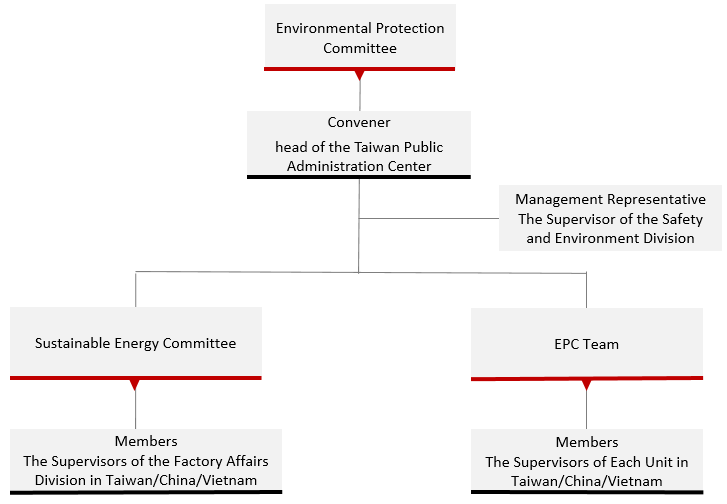
Upholding the aim to implement energy conservation mechanisms, reduce greenhouse gas emissions, fulfill corporate social responsibility, improve the overall corporate image, reduce operating cost, and assure sustainable business and development, Coretronic established the Environmental Protection Committee (EPC) in 2015. The head of the Integrated Business Service serves as the “Convener”, the divisionlevel manager of the Integrated Business Service serves as the “Committee Chair”, the supervisor of the Safety and Environment Division serves as the “Management Representative”, and the supervisors of each unit or representative such as R&D, Manufacturing, Quality Assurance, Procurement, Facility Management, Safety and Environment, and Factory Affairs serve as “Members”. Additionally, the Company set up the Sustainable Energy Committee and the EPC Team under the jurisdiction of the EPC.
Environmental Protection Committee and EPC Team
✔ Review short-, medium-, and long-term net-zero goals and implementation results on a quarterly and annually basis.
✔ Establish, plan, and implement targets, strategies, and action plans for climate change, carbon peaking, carbon neutrality, and net-zero.
✔ Conduct climate-related risks and opportunities identification.
✔ Promote pollution prevention, emergency response, and preventive measures.
✔ Focus on and advocate key points of international initiatives.
✔ Integrate and implement measures related to green actions.
Sustainable Energy Committee
The division-level manager of the Integrated Business Service serves as the “Committee Chair”, and the supervisors of the Factory Affairs Division from each factory serve as “Members”.
✔ Review electricity, renewable energy, and water resource usage on a weekly, monthly, and quarterly basis.
✔ Promote corporate energy conservation, carbon reduction projects, and energy transition.
✔ Implement short-, medium-, and long-term net-zero strategies and goals.
✔ Report the status of goal achievement to the EPC on a quarterly basis.
Strategies for Climate-Related Risks
Submitted a commitment letter to SBTi in 2022, committing to set emission reduction targets based on the SBT 1.5°C scenario. Submitted science-based targets to SBTi for review in 2023. Reduction targets approved by SBTi in 2024: “Reduce absolute scope 1 and 2 GHG emissions 50.4% by 2032 from a 2021 base year, and reduce absolute scope 3 GHG emissions 30% within the same timeframe”
In 2025, in addition to re-identifying climate-related risks and opportunities in accordance with the recommendations of the Task Force on Climate-related Financial Disclosures (TCFD) and further refining its climate adaptation strategies, Coretronic deepened its climate scenario analysis and, for the first time, comprehensively translated potential climate-related risks and opportunities into financial impact indicators. Through monetized assessments, the Company gained a more concrete understanding of the financial implications of climate risks, thereby strengthening the linkage between financial resilience and business strategy. Furthermore, the Company adopted the Taskforce on Nature-related Financial Disclosures (TNFD) framework and the LEAP approach to systematically analyze the dependencies and impacts of its operating sites on nature, enhancing organizational resilience to both nature- and climate-related challenges while reducing adverse environmental impacts.
Responded to the CDP questionnaire for seven consecutive years and has achieved an “A” Leadership level rating for both Climate Change and Supplier Engagement categories for two consecutive years, demonstrating its outstanding sustainability performance.
Joined the Taiwan Climate Partnership (TCP) and the Taiwan Alliance for Net Zero Emissions (TANZE) in 2022. Coretronic Corporation also awarded the “Gold Net Zero Label” from TANZE in 2025.
To achieve its net-zero goals, Coretronic has established a green product development strategy centered on the Sustainable Development Goals (SDGs), the SBT decarbonization pathway, the “Sustainable Raw Material Policy”, and green product design guidelines. The Company has set clear short-, medium-, and long-term quantitative targets across every stage of the product life cycle.