Issue Date: August 21, 2026
Quality Management
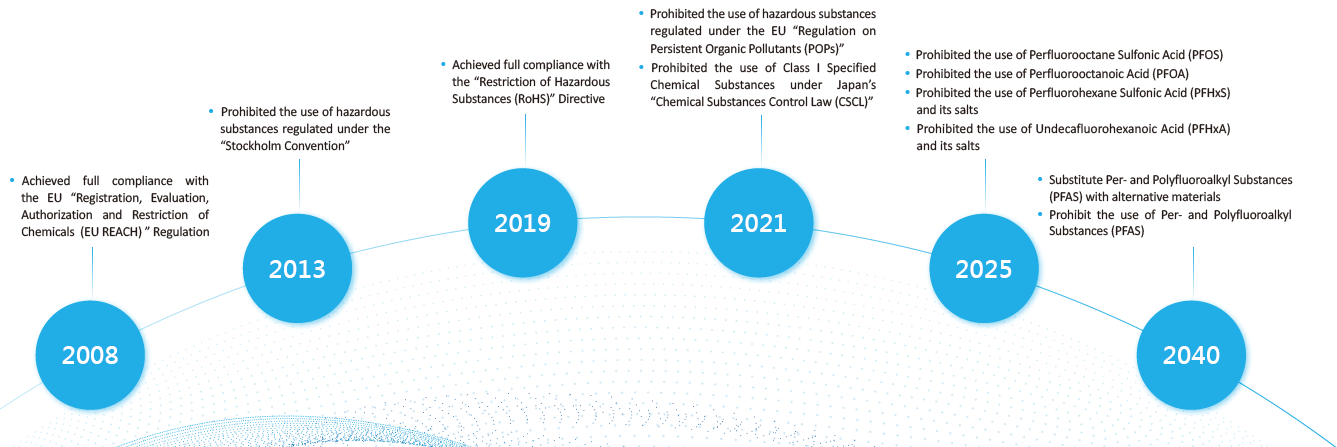
In response to the issue of Per- and Polyfluoroalkyl Substances (PFAS), which has become a major concern among customers, the Company has initiated supply chain investigations and management measures and has committed to fully phasing out and substituting PFAS before 2040. In terms of management practices, the Company conducts annual hazardous substance risk assessments for all products, covering customer-designated and customer-supplied materials. For customer-designated and customer-supplied materials, the Company actively promotes a risk reporting mechanism. If hazardous substances are identified, the Company will proactively provide risk reports and assist customers in evaluating alternative solutions, while respecting customers’ final decisions regarding their designated and supplied materials.
In 2025, no incidents of non-compliance with health and safety regulations related to products and services occurred, and green raw material procurement amount accounted for 92% of total raw material procurement amount.
▶ Hazardous Substance Management Commitments
Conduct annual hazardous substance risk assessments for all products to ensure they do not pose risks to human health or the environment.
Ensure that 100% of the Company’s products comply with prohibited/restricted hazardous substance requirements, international regulations, and customer requirements.
Continue investing R&D resources and budgets to gradually substitute and phase out high-risk hazardous substances.
Establish target timelines for the complete phase-out and substitution of prohibited/restricted hazardous substances and review progress toward these targets annually.
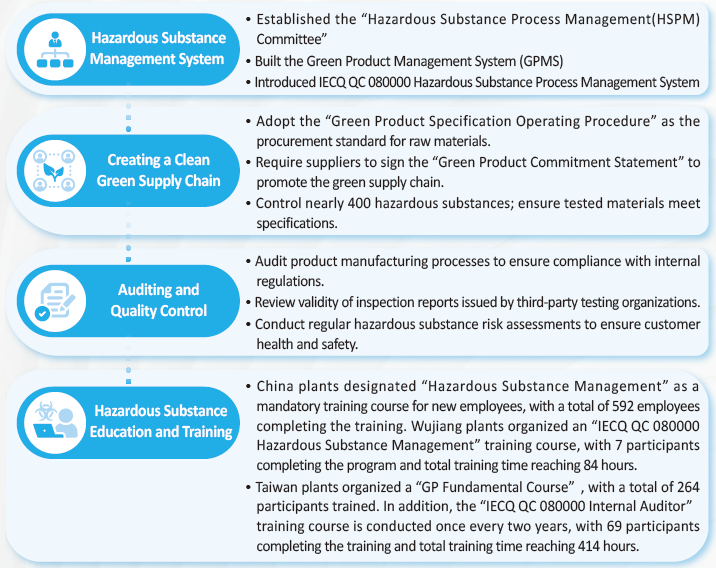
▶ Hazardous Substance Management Procedure
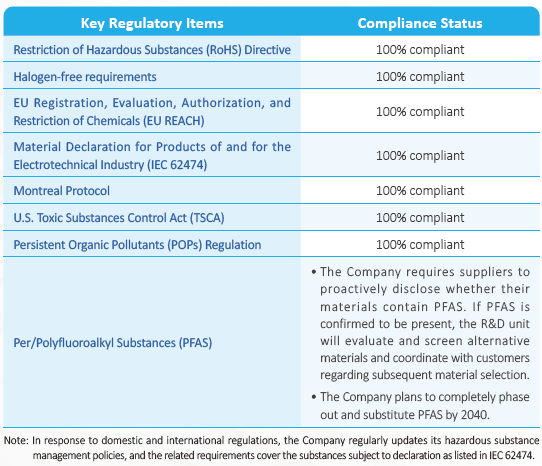
▶ International Hazardous Substance Management Performance
▶ Hazardous Substance Risk Assessment
The Company conducts annual hazardous substance risk assessments for all products. Specific practices are as follows:
Reference to International Standards: The Company identifies hazardous substances of major concern in accordance with relevant regulations such as the “EU REACH Regulation” and the “Restriction of Hazardous Substances (RoHS) Directive”. The Company continuously tracks products regulated under the “RoHS Directive” and the “EU REACH Regulation”. In 2025, the percentage of revenue generated from products non-compliant with the “EU REACH Regulation” and the “RoHS Directive” was 0%.
Hazardous Substance Identification: The Company independently developed and established a “Green Product Management System (GPMS)”, which incorporates a hazardous substance reduction and management system. Green material management is conducted in accordance with the “Green Product Specification Operating Procedure”.
Supply Chain Management: Materials, components, and semi-finished products provided by suppliers are required to comply with hazardous substance control requirements for green products and must be accompanied by homogeneous material testing reports issued by third-party organizations.
Hazardous Substance Risk Assessment and Analysis: By analyzing hazardous substances within the product mix, the Company identifies potentially hazardous substances contained in products, such as heavy metals, persistent organic pollutants, and toxic chemicals, to ensure that the Company’s products do not pose risks to human health or the environment.
▶ Gradual Phase-Out of Hazardous Substances