
Issue Date: August 21, 2026
Water Resource Management
Coretronic primarily sources its water from municipal supplies, with usage mainly for air conditioning, domestic needs, and catering services. Water users include employees, visitors, and contractors. Based on the Company’s operational characteristics, which primarily involve non-process water usage, the overall environmental impact is relatively minimal. However, considering that water resource management is a major global sustainability concern, the Company has incorporated water resource management into its overall “Environmental Sustainability Policy” and the TCFD framework to establish a comprehensive and effective management mechanism. This includes implementing tracking and management of water sources and flows, systematically assessing the Company’s dependence on water resources and related potential risks arising from operational activities, and prudently identifying trade-offs between water usage processes and environmental issues. Through these efforts, the Company continuously improves overall water use efficiency and actively responds to the United Nations Sustainable Development Goals (SDGs) 6: Clean Water and Sanitation.
“Water Resource Management Policy”
The Environmental Protection Committee shall convene related departments to formulate water resource management targets and quantitative performance indicators. The Environmental Protection Committee shall also periodically review both management performance and continuous improvement efforts in order to ensure the targets are achieved.
The Company shall introduce water resource management systems, implement all water conservation programs in a rigorous manner, and establish water conservation targets in order to reduce water withdrawal and consumption. In parallel with this, we also improve water usage rates, to promote sustainable development for water resources and freshwater ecosystems.
Through water resource initiatives and education, the Company shall strengthen external and internal stakeholder engagement, as well as the understanding of, sense of responsibility for, and respect for water resources among our upstream and downstream value chain partners. By implementing collective action, we will work together with all concerned to promote sustainable water resource management.
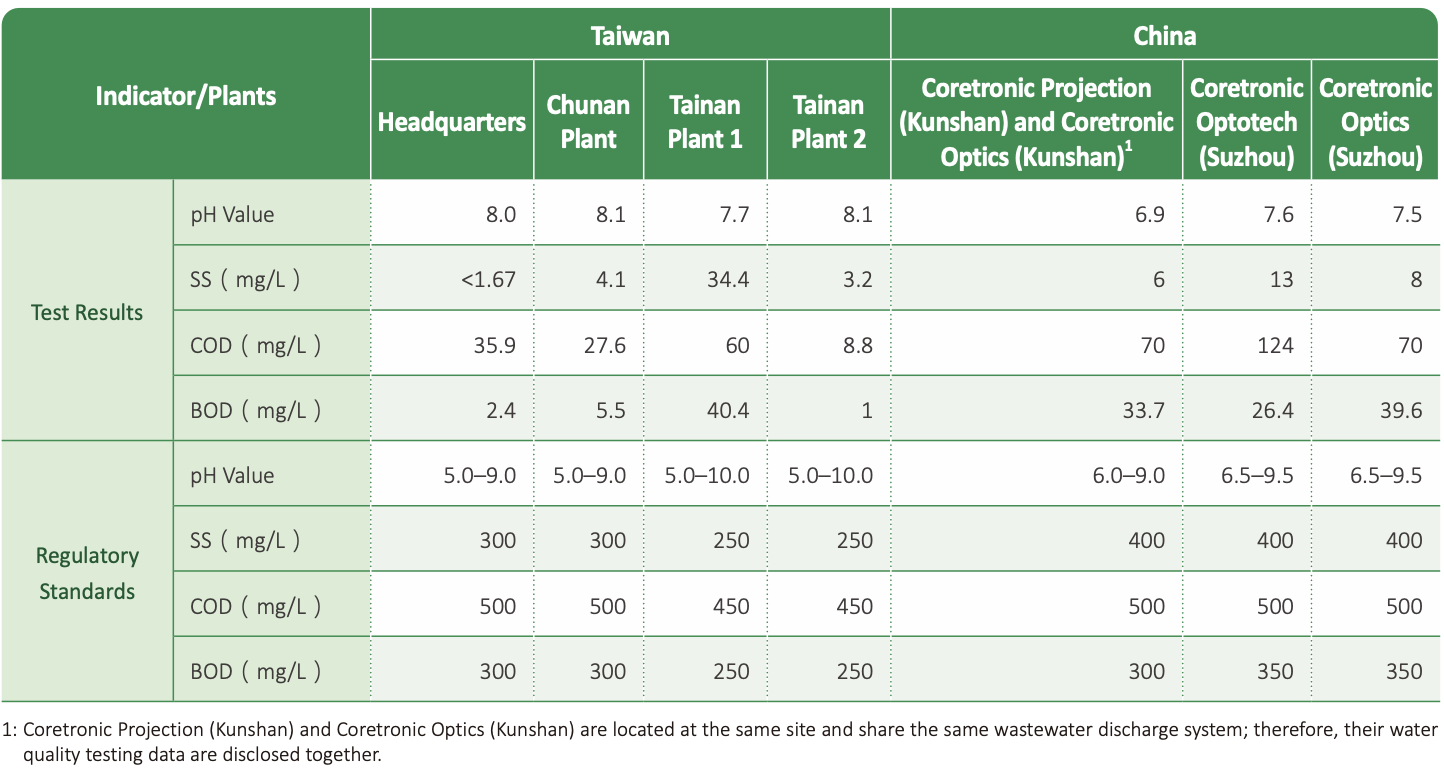
Coretronic's discharge standards shall exceed local regulatory requirements. The Company will conduct periodic water quality testing and disclose the relevant data to control, reduce, or eliminate water pollutants, and to reduce or eliminate harmful substances in discharged water.
The Company shall ensure that the water, sanitation, and hygiene (WASH) needs of all operating sites and the communities in which they are located are adequately safeguarded, and prevent its operations from causing adverse impacts on local water resources and the environment.
Water Resource Risk Assessment
Coretronic conducts a comprehensive water risk analysis using the Aqueduct Water Risk Atlas developed by the World Resources Institute (WRI). The analysis results indicate that Taiwan plants are classified as low to medium water risk areas (levels 1–2), while China plants face high water risk levels (levels 3–4). In light of the potential exacerbation of water scarcity risks due to climate change, Coretronic will continue to monitor water usage and water stress levels, regularly assess and revise water optimization strategies to ensure effective management and sustainable use of water resources. Currently, all sites implement water recycling and conservation measures to mitigate water-related impacts. The Company also promotes water-saving awareness to proactively prevent potential water shortages during dry seasons.

Note: The individual plants within Wujiang plants ((Coretronic Optotech (Suzhou) and Coretronic Optics (Suzhou)) and Kunshan plants (Coretronic Projection (Kunshan) and Coretronic Optics (Kunshan)) are located within the same water resource risk areas, and therefore water-related risk disclosures are not presented on an individual plant basis.
Water Usage Status
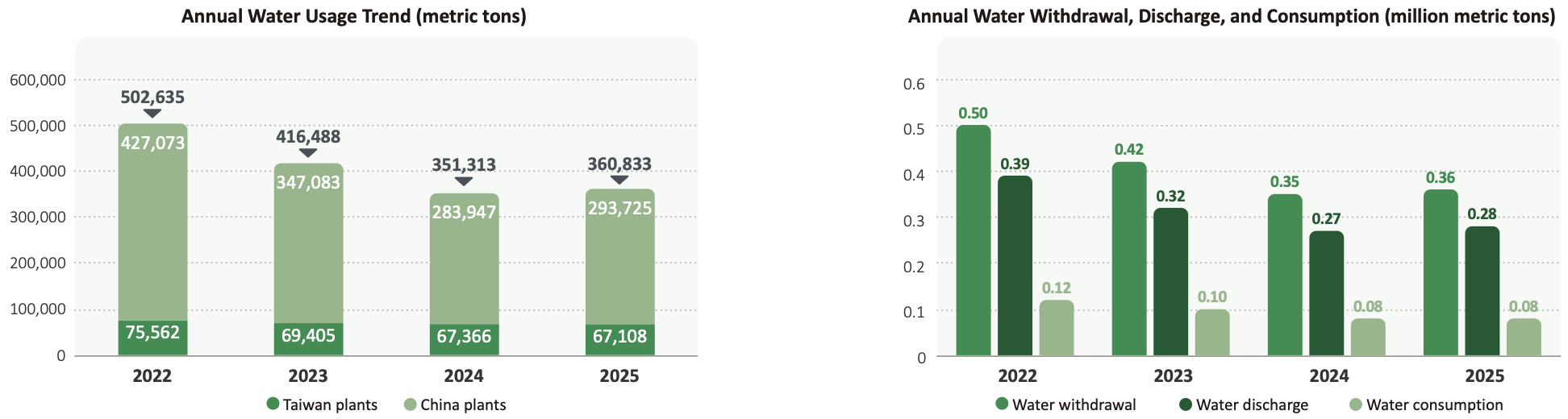
Coretronic’s total water consumption in 2025 was 360,833 metric tons, representing a significant reduction of 39% compared to the base year (2021), successfully achieving the short-term target. Although the addition of new production lines at Coretronic Optics (Suzhou) resulted in a slight 3% increase in overall water consumption compared to 2024, all plants continued to actively implement water-saving measures. Water consumption at Taiwan plants decreased by 0.4% compared to 2024 (and by 10% compared to the base year), while China plants achieved a significant 43% reduction compared to the base year (despite a 3% increase compared to 2024). Going forward, the Company will adopt more proactive water reduction measures to mitigate the impacts of climate change.
Water Conservation Measures and Performance
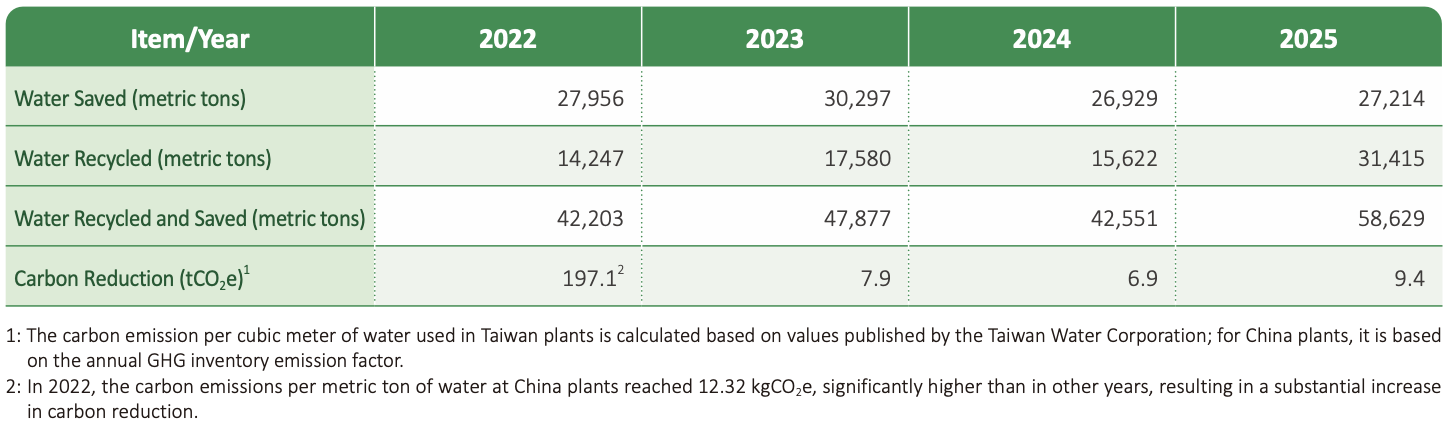
All Taiwan plants and Coretronic Optics (Suzhou) are equipped with water recycling systems, primarily collecting surface water, air-conditioning condensate, and rainwater for landscape irrigation and secondary domestic use. Coretronic Optotech (Suzhou) will also install a water recycling system in 2026. In addition, all plants have implemented various water-saving measures, including adjusting cycles of concentration in air conditioning, installing water-saving devices on faucets (such as aerators and motion-sensor taps), monitoring water usage in catering services, and reducing cleaning-related water consumption, in order to achieve water reduction targets.
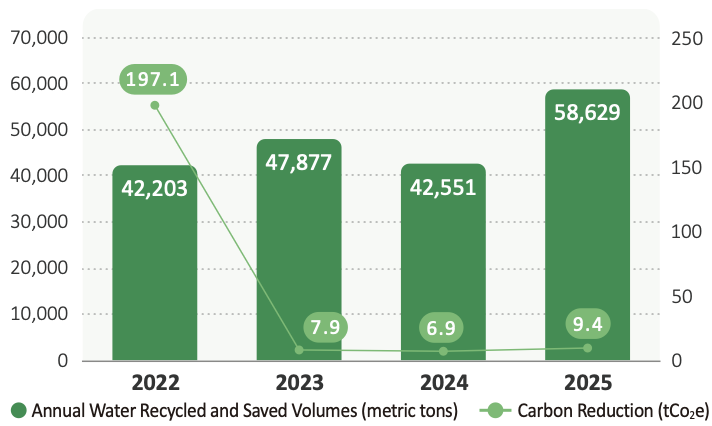
Since 2018, Coretronic has promoted various recycling and water-saving initiatives. As of 2025, the total volume of water saved and recycled reached 265,629 metric tons, resulting in a carbon reduction of 233 tCO2e.
Annual Water Recycled and Saved Performance Trend
Water Quality Management
The Company’s wastewater primarily originates from domestic sewage generated by employees. In 2025, total wastewater discharge amounted to 0.28 million metric tons. All wastewater discharges complied with local regulatory requirements. The Company strictly treats wastewater in accordance with local regulations and conducts regular water quality testing to monitor wastewater discharge conditions and ensure that discharge quality complies with local regulatory standards. If any non-compliance is identified, corrective action plans will be immediately initiated to prevent impacts on natural water bodies and the ecological environment.