
Issue Date: August 23, 2026
Safe Working Environment
Employees are the key driving force behind the Company’s continuous innovation and sustainable development. Therefore, it is the Company’s responsibility to provide a safe working environment. Coretronic takes "building a safe and healthy workplace" and "zero occupational accidents" as the management goals of a safe working environment, with the aim of ensuring that all Coretronic employees and workers can perform their duties in a healthy and safe environment.
Occupational Safety and Health Management System
Coretronic has fully institutionalized environmental safety and health management regulations for employees and workers to follow, and has formulated an “Occupational Safety and Health Policy”. Through regular reviews of occupational safety and health performance, strengthened personnel education and training, implementation of risk management, and periodic on-site inspections, the Company ensures workplace safety. In 2025, the scope of internal and external verification of the occupational safety and health management system covered the number of employees and workers reported in the "Occupational Accident Management". Additionally, to implement and introduce hazard prevention measures and related management regulations in accordance with national laws and regulations, and the nature of different workplaces, the top supervisor establishes a safety and health organization and an Occupational Safety and Health Committee. Occupational safety and health personnel at each plant are responsible for third-party verification audits of ISO 45001 Occupational Health and Safety Management System. The verification pass rate of Taiwan plants, Wujiang plants, and Coretronic Projection (Kunshan)1 achieved 100%. Currently, all certificates remain valid, ensuring the continuous and effective operation of the management system. Under the ISO 45001 management system, the number of employees covered by internal audits2 is 4,142, the number of non-employees is 478, and the audit coverage ratio is 100%; the number of employees covered by external audits is 4,041, the number of non-employees is 426, and the audit coverage ratios are 98% and 89% respectively.
Taiwan plants also obtained CNS 45001 verification to comply with the requirements of CNS 45001 and the specific audit focus items of TOSHMS. Through the implementation of the work plans of each management cycle, the Company aims to achieve continuous improvement, reduce occupational accidents, and ensure the safety and health of all employees and stakeholders.
1: Coretronic Optics (Kunshan) is the upstream supplier of Coretronic Projection (Kunshan), and their work environment safety systems are jointly managed. In the future, it will pass the ISO 45001 verification according to customer needs.
2: Employee and worker numbers cited in this section are average monthly headcount from January to December 2025, rounded up to the nearest whole number.; for Taiwan plants, they are based on reported occupational accident statistics from January to December 2025; those for China plants, they are based on HR system data.
Occupational Safety Risk Management
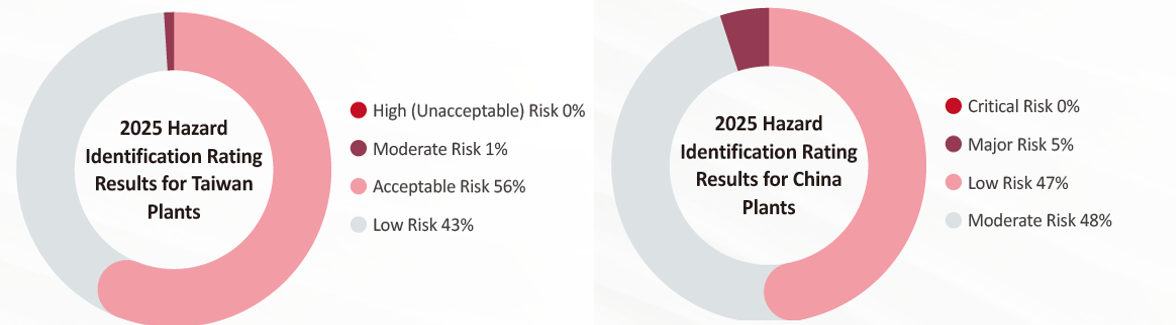
The Company has established the “Hazard Identification and Risk Assessment Operation Specifications”, and the management unit promotes each department to regularly review and revise hazard identification and risk assessment data every year. Before changes in manufacturing process, equipment, raw materials, and working environment, hazard identification is conducted according to chemical, physical, ergonomic, biological, and other safety and health (including workplace psychosocial) hazards, and personnel related to the implementation of hazard identification and risk assessment are required to receive at least three hours of risk assessment related training. Each department classifies different work environments, equipment or manufacturing processes, conducts job and operation inspections according to possible hazards, and cooperates with the operation process of each department to expand and fill in each operation step in the "Hazard Identification and Risk Assessment Form". Based on the severity and probability, the risk level is converted, and risk control is judged and adopted. If a major occupational accident occurs, it will be listed as a high risk level and risk control will be carried out.
For high-risk (unacceptable risk) or major hazard items identified at each plant, improvement plans and related action programs are prioritized and implemented to achieve the targets of “reducing the Lost Time Injury Frequency Rate (LTIFR)” and “zero major occupational accidents”, thereby providing employees and workers with a safe working environment. In 2025, all Taiwan and China plants completed operational risk assessments, and no high-risk (unacceptable risk) or major hazard items were identified. For medium-risk or relatively significant hazard items, the Company implemented the following corresponding solutions:
Physical and ergonomic hazards in office environments: To reduce visual strain on workers and enhance operational safety, the Company launched an office lighting improvement program beginning in 2025, replacing lighting fixtures with high-efficiency LED panel lighting systems to ensure uniform illumination levels exceeding regulatory standards and create a bright, comfortable, and healthy workplace environment.
Workplace psychosocial hazards: The Company has established the “Workplace Unlawful Infringement Prevention and Complaint Handling Guidelines” and the “Measures for Prevention, Complaint Handling, and Disciplinary Actions for Sexual Harassment”. The Company also adopts a “zero tolerance” policy toward workplace violence and misconduct in order to build a workplace environment that is safe, dignified, non-discriminatory, mutually respectful, inclusive, and provides equal opportunities.
Referring to the local government occupational safety and health regulations in Taiwan and China, in the event of an immediate danger in the workplace, the employer or the person in charge of the workplace must stop the operation and have employees evacuate to a safe place; if employees consider that the duties they perform have potential hazard risks, they should stop the operation and evacuate to a safe place on their own without endangering the safety of other workers, and immediately report to their direct supervisor. For employees who actively report and evacuate due to occupational safety hazard concerns, no disciplinary action will be taken under relevant operational regulations.
Occupational Safety and Health Organization
Taiwan and China plants have occupational safety and health management units responsible for planning, supervising, and promoting labor safety and health related business. To smoothly promote and implement safety and health work, the PDCA management mechanism is used to continuously improve the risks of personnel, equipment, and environment, raise employees' self-safety awareness, and jointly achieve the goal of zero accidents.
Occupational Safety and Health Performance Indicators | ||
|---|---|---|
|
|
|
Occupational Safety Consultation, Participation, and Communication
To foster a comfortable and safe environment and promote communication between labor and management, Taiwan plants convene “Occupational Safety and Health Committee” meetings on a quarterly basis, while China plants also regularly hold quarterly "Occupational Health Management Committee" meetings and "Safety Regular Meetings". The committee members are composed of supervisors at all levels, safety and health personnel, and labor representatives. Their responsibilities are to put forward suggestions on the Company's “Occupational Safety and Health Policy”, and to review, coordinate, and suggest safety and health related matters. Committee members jointly participate in decision-making concerning the planning and operation of occupational safety and health systems, and meeting outcomes are announced through written or electronic means. All employees are encouraged to put forward occupational safety related suggestions through the "Environmental, Safety and Health (ESH) Zone Suggestion Platform". Upon receiving notifications, management units proactively provide assistance and ensure that employees are protected from retaliation or inappropriate treatment when participating in occupational safety and health matters or reporting hazards. For contractors, occupational safety issues are promoted, consulted upon, and communicated through the annual coordination meetings. In 2025, a total of 24 Occupational Safety and Health Committee meetings and 70 contractor coordination meetings were convened. No work safety-related dispute incidents occurred in 2025.
The proportion of labor representatives at the 2025 Occupational Safety and Health Committee meetings for various plants | Taiwan | China | |||||
|---|---|---|---|---|---|---|---|
Matters Promoted for Discussion and Consultation | Meeting frequency | Quarterly | Quarterly | ||||
| Plants | Headquarters | Chunan Plant | Tainan Plant 1 | Tainan Plant 2 | Kunshan Plants | Wujiang Plants |
| Number of labor representatives | 8 | 10 | 8 | 3 | 10 | 4 | |
| Total number of committee members | 17 | 22 | 22 | 9 | 27 | 16 | |
Proportion | 47% | 45% | 36% | 33% | 37% | 25% | |
Occupational Safety and Health Education and Training
To ensure that all employees are well-informed about occupational safety and health regulations and the Company’s safety and health management systems, the Company has established the “ESH Education and Training Operating Procedures”. In compliance with regulatory requirements and job-specific needs, the Company provides “employee safety and health training” courses to raise employees’ safety and health awareness. In 2025, the occupational safety and health education and training courses recorded a total of 18,084 participants, totaling 59,013 training hours. On-the-job safety and health education and training includes programs for occupational safety and health business supervisors, occupational safety and health management personnel, hazardous operations supervisors, fire management personnel, and Occupational Safety and Health Committee members, as well as the statutory employee retraining , and the annual contractor onboarding training.
▶ 2025 Training Results
Item | Taiwan | China | Total |
|---|---|---|---|
| Occupational Safety Training for New Employees (participants) | 399 | 1,452 | 1,851 |
| Annual Fire/Civil Defense Team Training (participant attendances) | 310 | 6,381 | 6,691 |
| Occupational Safety and Health On- the-job Training (participant attendances) | 1,934 | 6,586 | 8,520 |
| Annual Contractor Onboarding Training (participants) | 931 | 91 | 1,022 |
| Total Training Attendance (participant attendances) | 3,574 | 14,510 | 18,084 |
| Total Training Time (hours) | 7,370 | 51,643 | 59,013 |
Disaster Response Drills
The Company conducts workplace fire risk identification and has identified electrical equipment and cooking operations as key high-risk sources. Accordingly, automatic fire detection and fire suppression systems have been installed to reduce disaster risks. In addition, to strengthen employees’ disaster prevention awareness and raise the crisis awareness and emergency response capabilities of emergency response team members, the Company reviews its emergency response plans annually and collaborates with fire departments and police departments to conduct plant fire safety and civil defense drills. Through practical drill training programs, employees’ emergency response capabilities are reinforced. In 2025, a total of 54 disaster response, fire safety, and civil defense drills were conducted. Including contractors, a total of 10,181 participants were recorded, with total training time amounting to 11,227 hours.
Occupational Accident Management
Through the implementation of the occupational safety and health management system, the Company has established a solid management foundation and comprehensive operational mechanisms. To address future challenges arising from business expansion, manufacturing technology upgrades, and climate change, the Company has shifted the strategic focus of occupational safety and health management from “system establishment and regulatory compliance” toward “strengthening safety resilience” and “embedding a safety culture”. Based on the results of annual material topic identification, the Company has designated the “Lost Time Injury Frequency Rate (LTIFR)” and the “number of major occupational accidents” as key management targets, prioritizing the implementation of related action plans to achieve continuous improvement in occupational safety and health management performance. The Company also promotes digital EHS education and training to strengthen the safety knowledge of employees and relevant stakeholders, reduce the likelihood of unsafe behaviors, cultivate proactive prevention awareness, and embed a culture of safety among all employees.
The Company systematically manages occupational accident risks. In addition to establishing occupational injury and accident management procedures, the Company has implemented an “Accident Report / Personnel Occupational Injury / EHS Anomaly Incident Handling Record” platform to document and track the causes of incidents as well as corrective and preventive actions. Whenever an occupational injury occurs, hazard factors are re-assessed and risks are re-evaluated to strengthen accident prevention. Through monthly internal inspections, adherence to accident management procedures, and investigation mechanisms under the reporting system, the Company conducts accident analysis and implements corrective improvements to ensure workplace safety.
In 2025, no major occupational injuries recorded, and no occupational injury incidents involving non-employee workers occurred. The LTIFR for employees was 1.11, while the LTIFR for non-employee workers was 0, both meeting the annual targets. Taiwan plants recorded a total of five near-miss incidents and three occupational injury incidents excluding traffic accidents, consisting of one case in which an employee was accidentally cut by a cooling fan during an experiment and two cases involving muscle strains caused by improper posture. All incidents underwent completed investigation and analysis, followed by implementation of corrective and preventive measures such as hazard communication regarding personnel walkways and equipment operation, safety awareness promotion, education and training, and installation of protective equipment, thereby strengthening personal safety awareness and reducing accident occurrence rates. China plants recorded a total of seven near-miss incidents and six occupational injury incidents excluding traffic accidents, including two cases at Wujiang plants involving injuries caused by falling objects, one collision with equipment incident, one cutting injury incident, and two slip-and-fall incidents. All incidents underwent completed investigation, analysis, and safety awareness promotion activities. To reduce occupational injury incidents, Wujiang plants strengthened measures including equipment shutdown maintenance, training programs regarding equipment usage essentials and operational safety, workplace 7S management, and implementation of on-site inspection activities.
From March 27, 2019 to December 31, 2025, the Chunan Plant participated in the “Zero Accident Hours Record Activity”, a self-managed occupational safety and health initiative promoted by the Industrial Safety and Health Association, with an average of 292 participants per month. By the end of 2025, the plant had accumulated 3,704,016 accident-free working hours, demonstrating the Company’s commitment to maintaining a safe working environment.
▶ 2025 Occupational Injury Records of Employees and Non-Employee Workers
Plant | Taiwan7 | China7 | ||
|---|---|---|---|---|
Indicator/Year | Employee | Non-Employee Workers | Employee | Non-Employee Workers |
Total Working Hours | 2,636,072 | 208,600 | 5,463,184 | 719,848 |
Number of Major Occupational Accidents2 | 0 | 0 | 0 | 0 |
Occupational Injury Fatality Rate1 | 0 | 0 | 0 | 0 |
Number of Severe Occupational Injuries2 | 0 | 0 | 0 | 0 |
Severe Occupational Injury Rate2 | 0 | 0 | 0 | 0 |
Number of Disabling Injuries3 | 5 | 0 | 6 | 0 |
Lost Days Due to Disabling Injuries3 | 35 | 0 | 67.5 | 0 |
Number of Recordable Occupational Injuries4 | 10 | 0 | 13 | 0 |
Total Recordable Injury Rate (TRIR)4 | 3.43 | 0 | 2.37 | 0 |
Lost Time Injury Frequency Rate (LTIFR)5 | 1.71 | 0 | 1.09 | 0 |
1. Occupational Injury Fatality Rate = (Total number of occupational injury fatalities / Total working hours) × 1,000,000 hours.
2. Severe Occupational Injury Rate = (Number of severe occupational injuries / Total working hours) × 1,000,000 hours. “Severe occupational injuries” refer to injuries resulting in an inability to recover to the pre-injury health condition within six months.
3. The number of disabling injuries refers to occupational injury cases required to be reported in accordance with formal announcements issued by the Occupational Safety and Health Administration (OSHA). Lost days due to disabling injuries refer to the number of lost days associated with occupational injuries required to be reported under OSHA regulations.
4. Total Recordable Injury Rate (TRIR) = (Number of recordable occupational injuries / Total working hours) × 1,000,000 hours. Recordable occupational injuries refer to the combined total of disabling injuries and near-miss incidents.
5. Lost Time Injury Frequency Rate (LTIFR) = (Total number of disabling injuries / Total working hours) × 1,000,000 hours.
6. Employee headcount and working hour statistics were calculated using the average monthly headcount from January to December 2025, rounded up to the nearest whole number. Calculations of Taiwan plants were based on occupational injury reporting data from January to December 2025, covering 1,384 employees, while calculations of China plants were based on HR system data covering 2,758 employees.
7. From 2022 to 2023, Taiwan plants include Coretronic (Headquarters, Chunan Plant, Tainan Plant 1, and Tainan Plant 2); China plants include Kunshan plants (Coretronic Projection (Kunshan), Coretronic Optics (Kunshan)) and Wujiang plants (Coretronic Display (Suzhou), Coretronic Optotech (Suzhou), and Coretronic Optics (Suzhou)). From 2024 to 2025, Taiwan plants include Coretronic (Headquarters, Chunan Plant, Tainan Plant 1, and Tainan Plant 2); China plants include Kunshan plants (Coretronic Projection (Kunshan), Coretronic Optics (Kunshan)) and Wujiang plants (Coretronic Optotech (Suzhou), and Coretronic Optics (Suzhou)).
8. All occupational injury indicators were truncated to two decimal places without rounding.